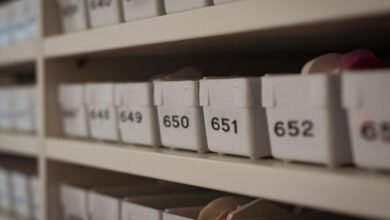
Study Number Record Collection for 3509159347, 3533969163, 3314623978, 3891439888, 3283286338, 3922057777, 3512152061, 3204474254, 3278827128, 3349328769


The study number record collection for 3509159347, 3533969163, 3314623978, 3891439888, 3283286338, 3922057777, 3512152061, 3204474254, 3278827128, and 3349328769 presents a structured ledger of identifiers aligned to a common schema. It supports provenance, versioning, and governance checks across research activities. The collection invites careful cross-comparison of timelines and data quality indicators, exposing recurring patterns and gaps. Its implications for reproducibility and auditability merit a measured, systematic follow-up.
What Is the Study Number Record Collection and Why It Matters?
The Study Number Record Collection comprises a systematically organized assemblage of identifiers assigned to individual studies, projects, or datasets, designed to track provenance, status, and metadata throughout the research lifecycle.
It stabilizes accountability and provenance, supporting structured governance.


This framework clarifies study design and emphasizes data quality, enabling reproducibility, auditability, and informed decision-making within multidisciplinary research environments.
How to Read and Compare Records Across the Ten Study Numbers
Across the ten study numbers, readers should proceed by systematically mapping each record’s core fields—identifier, status, metadata, and provenance—to a common schema, enabling direct comparison of attributes such as timeline, data quality indicators, and governance level. This approach clarifies reading patterns while preserving data integrity, enabling independent evaluation, reproducibility, and transparent cross-record assessment without distortion or redundancy.
Key Patterns, Gaps, and Data Integrity Implications in the Collection
Examining the compilation data reveals recurring patterns, notable gaps, and implications for data integrity across the collection.
The study design informs sampling balance, while data governance defines provenance, versioning, and access controls.
Identified gaps highlight missing fields and inconsistent encoding.
2 two word discussion ideas about Subtopic not relevant to the Other H2s listed above: governance clarity, design robustness.
Practical Applications and Next Steps for Researchers and Practitioners
This study offers practical applications and identifies next steps for researchers and practitioners by translating patterns, gaps, and governance considerations into actionable guidance. The proposed framework supports data ethics compliance and transparent assessment of funding sources.
Practitioners can implement standardized protocols, audit trails, and governance checks.
Researchers should prioritize replicable methods, ethical review, and cross-disciplinary collaboration to strengthen methodological rigor and sustained impact.
Frequently Asked Questions
How Were the Ten Study Numbers Originally Generated?
How generated: numbers were derived via a deterministic encoding scheme applied to anonymized identifiers, balancing traceability with privacy considerations, ensuring non-reversible mapping. The process prioritized privacy considerations while preserving archival integrity and consistent study-number generation.
What Privacy Considerations Apply to This Collection?
Privacy concerns arise regarding collection scope and protection measures; data ownership remains with participants or custodians as defined by policy. The archive emphasizes minimized exposure, access controls, and transparent governance to uphold consent, accountability, and responsible data stewardship.
Are There Known Biases Affecting the Data in the Set?
“Every pot has a lid.” The analysis notes potential biases exist; known biases affect sampling, labeling, and coverage. Bias awareness and data lineage are central, with methodical documentation ensuring transparency while preserving a sense of investigative freedom.
How Often Is the Data in the Collection Updated?
Data latency and update frequency are not fixed; they vary by source and workflow. The record collection undergoes periodic refreshes, with documented intervals aligned to data provider schedules, ensuring traceable, auditable timeliness and controlled archival integrity for users seeking autonomy.
What Tools Were Used to Ensure Data Provenance?
Tools ensuring data provenance include immutable audit trails, standardized data lineage documentation, and reproducible workflow systems; collectively they support traceability, reproducibility, and enduring archival integrity without relying on informal practices.
Conclusion
The study number record collection exemplifies disciplined provenance: an auditable ledger where each identifier maps to a stable core schema. A concise anecdote illustrates resilience: a single metadata amendment corrected downstream versioning across ten records, preserving audit trails. This demonstrates that meticulous indexing safeguards reproducibility and governance. Yet gaps persist in backward compatibility and temporal tagging; ongoing reconciliation is essential. Practitioners should implement standardized validators and version histories to maintain data integrity over lifecycle trajectories.